
The Human Family
& Everything Else
The Universal Declaration of Human Rights, the reality it built for nature, and what could come next
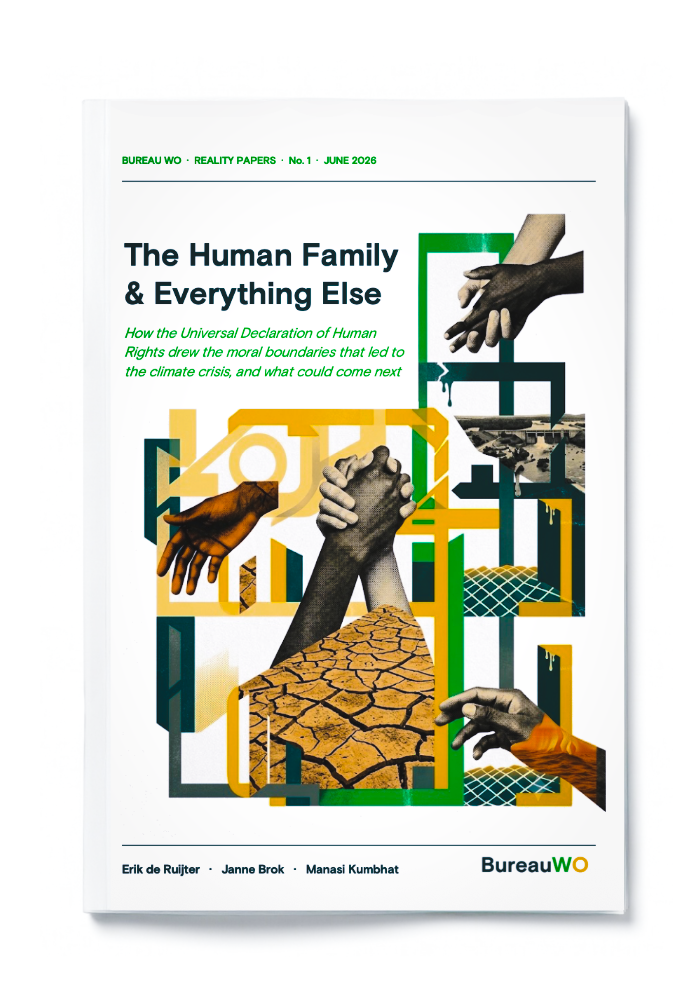
The way we talk about climate change and human rights runs in one direction: climate change threatens human rights, and we need to reverse climate change to protect these rights.
It is true… but that picture is incomplete.
This publication shows that the arrow of causation runs the other way too.
The Universal Declaration of Human Rights, adopted in 1948 without a single dissenting vote, built a moral architecture for the world. It defined who belongs to the "human family," and in doing so, it drew a boundary. Everything inside that boundary received the right to exist, to legal standing, to protection from cruelty. Everything outside it, every ecosystem, river, species and forest the human family depends on, received the structural inverse. That inverse was never debated. It followed from where the line was drawn. And it was then built into our political, legal and economic systems for 78 years.
A framework that grants universal rights to humans and zero rights to the living systems humans depend on is not a stable framework.
It is a framework that consumes its own preconditions. That is what the climate crisis is.
What You'll Find Inside
01The causal arrow that hasn’t been talked about
Instead of treating climate change as a threat to human rights, this paper reverses the lens and asks whether the human rights framework itself, by defining the boundary of moral and legal concern at the edge of the human family, structurally produced the crisis it now claims to be threatened by.
For nearly every choice the Universal Declaration of human Rights made for humans, the implied position for nature is the exact inverse: no right to exist, no legal standing, no protection from cruelty. That reframe changes what counts as a solution.
02The fragments belong to the same puzzle
What do the degrowth movement, the rights-for-nature movement, the Welsh Well-being of Future Generations Act and France's 2017 Duty of Vigilance Law have in common? They are all working on pieces of the same underlying problem.
But without a shared structural diagnosis, they have been pulling in different directions, winning individual battles inside a system architecture that keeps producing the destruction they are trying to stop. This publication provides the shared diagnosis.

03We are not starting from scratch
The alternative realities in this paper will sound radical. They require rethinking property, sovereignty, legal personhood and how we measure economic output. But the precedents assembled across these pages tell a different story.
Seeing them in one place, connected to a single analytical structure, shows that the building blocks already exist. What is missing is the coherence that makes them hold together. That’s what is being offered.
Written for people who sense the architecture is wrong
Anyone who senses that the problem is not a missing regulation or a missing technology but something deeper in how we have organised the relationship between human civilisation and the living world.
-
Policy makers and institutional leaders working on climate, environment, human rights or governance who need a structural diagnosis that connects their domain to the others, and a language for the systemic change that incremental reform cannot deliver.
-
Practitioners in the rights-for-nature, degrowth, stop-ecocide and regenerative movements who recognise that their individual wins keep being absorbed by a system designed to produce the outcomes they are fighting. This publication provides the shared structural map.
-
Systems thinkers, academics and researchers in sustainability, law, political economy and Earth systems science who want a rigorous analytical framework for reading existing systems as configurations of choices and generating coherent alternatives.