
Two kinds of change
Most change is incremental: a process tightened, an asset upgraded, a fault fixed.
The world runs on this and it is necessary. It is not always enough.
Some problems are produced by the system itself. You cannot patch your way out of those.
You need a different reality, and nobody has a systematic method for designing one.
That is what the framework is built for.
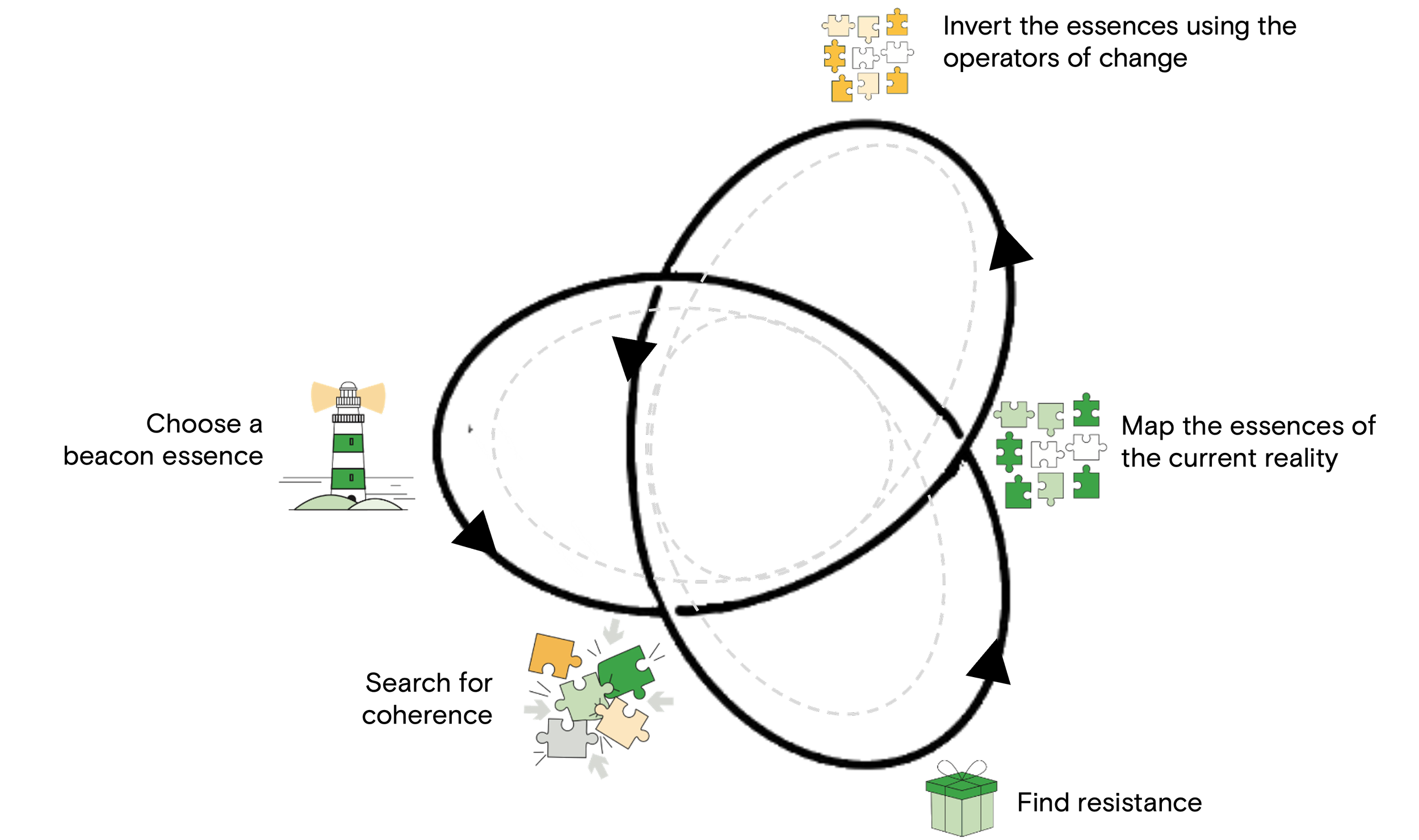
*This is a simplified design process, for the purpose of illustrationThe approach in brief
A method for redesigning a reality from first principles.
It draws on complexity theory, systems thinking, linguistics, and by extension set theory.
THE VOCABULARY
Reading a reality as a set of choices
You map the current reality as a set of essences, the dimensions along which a choice has been made, and manifestations, the specific choice currently occupying each dimension.
When deconstructing the reality implied by the Universal Declaration of Human Rights (UDHR), for example, ‘Who holds rights’ is an essence; "human beings" is its present manifestation. A full set of manifestations that hold together, we call a reality.
Read this way, the facts of a system turn back into what they always were: choices.
THE MAIN MOVE
Inversion: the move that removes the guesswork
For each manifestation we ask what the current choice is not. We call this an inversion. Instead of being asked to imagine something from a blank page you are asked to identify what the present is not, a question with a definable answer.
The inversions use three operators grounded in language: presence (is or isn't), magnitude (a little or a lot), and hierarchy (a part or the whole).
THE ITERATIVE SEARCH FOR COHERENCE
Coherence: where the real work is
Generating alternatives is the easy part. The hard part is coherence: assembling the inverted manifestations into a reality and stress-testing it for where they work against each other.
Change one manifestation and it usually forces changes elsewhere. Where the changes don’t align or fit with the other, you’ll find resistance from people which is often a signal that you found a new essence or need to look for a different manifestation. That resistance is an informative signal, not a failure.
The Reality Canvas

This is a Reality Canvas mapping the essences of the Universal Declaration of Human Rights from our Reality Paper: The Human Family & Everything Else
Click to enlarge
We map all of this on the Reality Canvas, a systems map built on the Sierpinski triangle, whose fractal geometry lets a system and its nested
sub-systems sit in one picture.
A canvas is built by many people together.
It is an interpretive lens, not a claim to objective truth.
The tools: Try it yourself
Once the framework makes sense, four canvases let you start mapping your own reality. They are free.
Small Reality Snippets — capture fragments of a reality as you hear them.
Large Reality Snippets — break a situation down into its essences.
Reality Canvas — present the structure of a current or proposed reality.
Inversion Canvas — apply the operators and collect the manifestations of a new reality.
